Trust & Technology
Field data should remain usable, verifiable and under customer control.
Fenwix Trust & Technology separates two subjects: what Fenwix Solo protects today and the enterprise architecture Fenwix is building toward. Today, the core workflow runs offline with encrypted app-private local records. The direction is a customer-owned data plane without default vendor custody of operational field content.
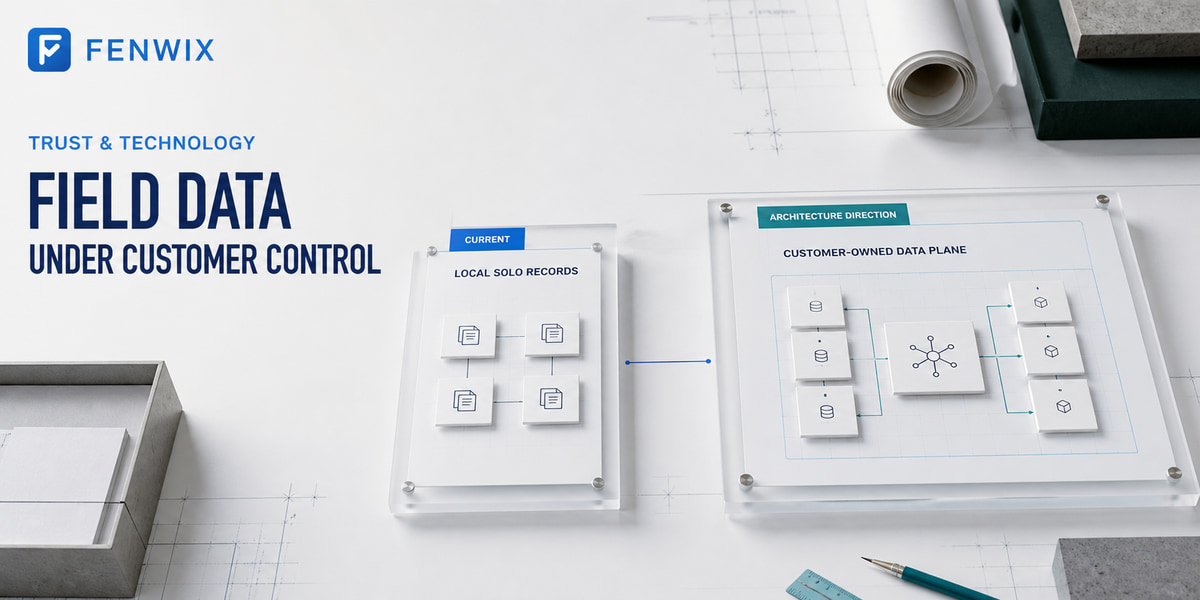
Available now and planned next are never presented as the same thing.
Trust requires precise boundaries. Every capability on this site is labeled according to its actual status so a current product control cannot be confused with a target architecture.
Available today
- Offline inspection with durable local writes
- Encrypted app-private database and evidence vault, no Fenwix account required for the core Solo workflow
- Stable record identities and a version-aware canonical bundle foundation
- Evidence SHA-256 hashes with capture source tracking
- Separate original / annotation model, originals never overwritten
- Completed-record revisions with report identity
- Local source-record verification with linked-photo recheck
- Asset history, due dates and out-of-service states
- Corrective-action evidence and verification steps
- Inspection content excluded from vendor analytics payloads
- Support has no default access to inspection content
Where the architecture is going
- Provider adapters and a durable synchronization queue
- Customer-owned shared storage, Google Shared Drive as first connector
- Provider-independent storage abstraction (OneDrive / SharePoint / S3 / Azure)
- Signed organization policy, RBAC, offline authorization TTL
- Cryptographic device/user signing
- Customer Relay and enterprise integrations
- Regulated and private deployment options
These are architecture targets, not shipped Solo capabilities. Status remains visible wherever a roadmap capability is described.
Field Assurance preserves the chain from inspection to verified outcome.
Inspection
   ↓
Evidence
   ↓
Finding
   ↓
Corrective Action
   ↓
Verification
   ↓
Asset History
   ↓
Audit / Report
The value of Fenwix is not the number of checklists it can display. The system is organized around preserving what happened after the checklist answer: the evidence, the finding, the corrective action, the verification decision and the resulting asset history.
Sections
Offline Engineering
The core Solo workflow uses durable local writes, local evidence, on-device PDF generation and local verification without requiring a cloud round trip.
CURRENTData Handling
Inspection content, product telemetry and voluntarily supplied support information are treated as separate data classes with different handling boundaries.
CURRENTEvidence Integrity
Content hashes, capture source, separate annotations, revisions and verification digests help reveal whether a record or linked file no longer matches its recorded state.
CURRENTReport Verification
Fenwix verifies the source inspection record available on the device. It does not present a public marketing URL as proof or claim that a PDF can never be altered elsewhere.
ARCHITECTURE DIRECTIONCustomer-Owned Data Plane
The target enterprise model keeps operational field data in customer-controlled storage behind a provider-independent protocol rather than making a Fenwix database its natural home.
ROADMAPConnector Architecture
Storage providers are planned as replaceable connectors. Google Shared Drive is first in the roadmap, followed by additional customer-controlled storage options.
Trust architecture and product capability serve different questions.
Fenwix.app explains the product used in the field. Fenwix.net explains the current data boundaries, evidence model, verification scope and clearly labeled enterprise direction.